Friday, November 8, 2013

Toilets of Asia

Bathrooms are always interesting, and especially so in Asia! So, here is a round-up of all the pictures we've taken of toilets on our trip.

The wonderful pre-fab bathroom in our hotel in Kyoto. The whole room is Toto model number ENV1418RA.

A gorgeous public stall in Arashiyama

A nice clean squatter in Japan.

The Way of the Future

Osaka hotel bathroom


And now, moving on to China. Warning, NSFW.

The nicest bathroom in China: the Fraser Suites in Chengdu.
Trainsquatting

The train had a western toilet with a beautiful solid wood lid. Remember to roll up your pant legs.


The stone walls of the Shambala Palace in Lhasa. Items belonging to Shambala Princess in foreground.


At 17200 ft, the highest altitude toilet we've ever used.


Squatter in Nagarze, the hometown of the 8th Dalai Lama's mother.
Typical small-town Tibet hotel bathroom.

Surprisingly nice bathroom in Shigatse, Tibet

And now, the award for Worst Toilet Ever goes to Shigatse, Tibet:


Be sure to check back for future updates!


Thursday, November 7, 2013

Driving Across Tibet to Nepal

Our driver and guide

After 3 nights in Lhasa, we were ready for a 5-day drive across Tibet. This was a smorgasbord of high-altitude scenery. It was an exciting drive, leading me to the #1 Rule for Driving In Tibet:


If you see anything on the road, honk the horn.
Honk continuously until there is nothing on the road.

There are enough yaks, cows, sheep, goats, kids, old ladies, etc. on the road that we’re just always honking. For many towns, our driver would simply drive through the entire town pressing the horn. You’d think it would get annoying, but it’s just how it is.
Honking
A lot of vehicles seem to be homebuilt. 

Yamdrok Lake


The Gyantse fort, built in 1390

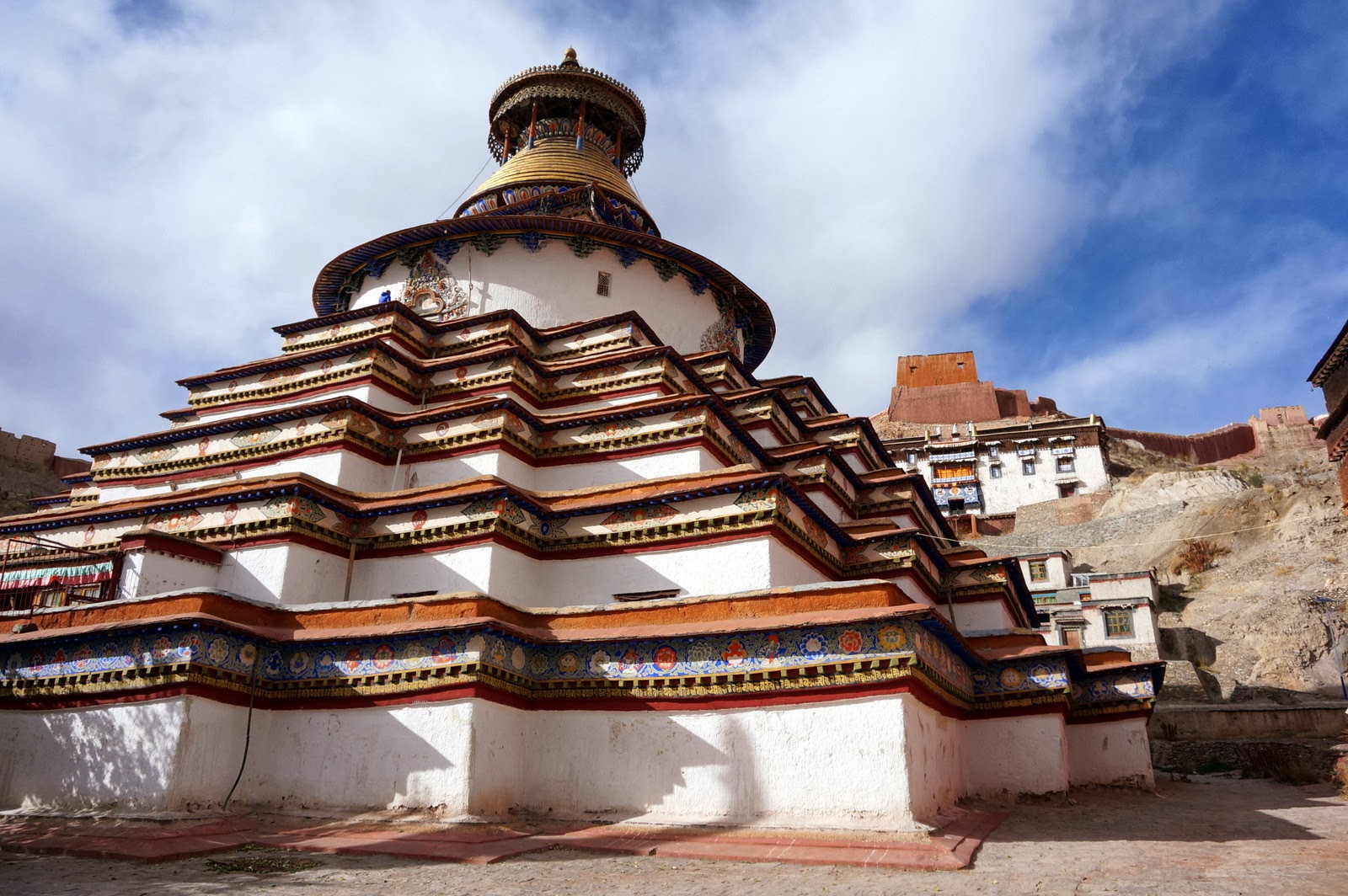
The Gyantse Kumbum


We saw a lot of these guys in the 77 chapels of the Gyantse Kumbum
The highest elevation of the journey: 5248m (17200')

We stayed in hotels in relatively small cities along the way. The hotels in small-town Tibet seem like old Chinese factories that someone decided to turn into hotels: big, cold, dark concrete buildings with almost no guests other than us. 

Typical hotel architecture

Our (least) favorite was in Tingri: despite a huge sign out front advertising “24-hour hot water”, there was no running water at all. We asked the manager (we think) how to flush the toilet and he said “bucket”, making a bailing motion. I went into the bathroom and found the 5 gallon bucket he was referring to. Still, it was empty. The solution to this was to go into an “under construction” section of the hotel that somehow had running water, fill up the bucket, and pour it into the toilet in our room, causing it to flush.

Actually no water at all, 24 hours a day. Occasional electricity.

They do one thing well: 3G cell service.
The power in Tingri goes on and off every half-hour or so. During the off times, the night sky is amazing.


The highlight of the drive was our visit to the Rongbu monastery, 20km from Mount Everest. We got lucky and had an unusually clear day, providing an unobstructed view.

The road to Everest.
Everest. Our guide says it's never this clear. 

It’s another surreal place up there. With almost no tourists, it’s a bunch of monks and a few nuns, continually chanting in the world’s highest monastery, with the world’s tallest mountain looming ahead.

The Rongbuk monastery, and its chanting nuns.

We ate lunch at the monastery and then embarked on the long drive down towards the Nepal border.
Through the Himalayas to Nepal

Tibet was the kind of place that you really feel like you're living in another time, in another world. At the same time, the people were extremely friendly, the scenery was incredible, and the culture very interesting.

Lhasa

We were greeted at the Lhasa train station by our guide for the week. Currently, you can’t travel to Tibet without hiring a guide to take care of you the whole time. Ours showed us to our hotel, recommended restaurants, and for the first two days showed us around the many temples and monasteries of Lhasa.

A pilgrimage around Barkhor square. Clockwise only.
At the center of Old Lhasa is Barkhor Square, around which crowds of pilgrims walk strictly in a clockwise direction, as dictated by the dominant Yellow Hat sect. Many periodically dive down, forehead touching the road, and essentially swim along the street. It’s an eerie scene, and they do it day and night.

Jokhang Temple in foreground, Potala Palace in background.
 
Pilgrims at Jokhang temple.

Monks debating at Sera Monastery
Potala Palace


Some precarious maintenance on Potala Palace

Apres-monastery 
Street scene in Lhasa 

Yak market

Upon arrival in Lhasa, Cindy came down with some nasty food poisoning, limiting her to about 5 hours out of bed per day. Since we were staying in the Shambala Palace hotel, I started calling her the Shambala Princess, which she appreciated.

Shambala Princess


The Train to Tibet – Day 2

Our second morning on the train was the other kind of National Geographic experience. We awoke to a world of ice and snow, mountains and smog-free blue sky. Still in Qinghai, the tracks are set in permafrost, rising to an elevation of 5070m at the Tibet border. We saw increasing numbers of Yak and sheep, herded by nomads living in both modern tents and mud huts. We think we saw wolves and Tibetan antelope, but in all honesty they could be dogs and deer. Still, everything is more exciting when seen from a train chugging along frozen tundra.

Nature.

Snow.

Yak/sheep herder villages.
We saw a lot of guys standing in the cold saluting the train for some reason.


The Train to Tibet – Day 1

This is Mike’s first stab at a blog entry.

We’ve spent the past 24 hours on a train, starting in Chengdu, Sichuan and are currently headed for Golmud. Qinghai. Tomorrow we will continue on to Lhasa, Tibet.

I’ve been calling this a prison on rails mainly due to the interior décor, the sleeping arrangements, and the scenery (more on this later). That’s not to say I’m not enjoying it – it’s a unique experience and I might feel the same way about 44 hours in jail.

A 6'x6'x7' room really can sleep 4.

When the room feels cramped, try the 2' wide corridor. 
The sleeping arrangements are tight. We spent last night in a 6’x6’ cabin with 2 other people, arranged in bunk beds separated by about 18”. Our roommates were friendly enough, even though we only had one mutually understood phrase between us. Thankfully the snorer of the two left the train today, so we are now down to 3 and I’m looking forward to a better sleep tonight.

It would be misleading to call today’s scenery spectacular, but it was certainly a spectacle. I used to read a lot of National Geographic when I was a kid, and they’d often contain a mix of articles describing spectacular natural beauty, followed by articles about toxic Soviet wastelands and nuclear disaster sites. Since then I’ve been fortunate to see plenty of natural beauty, so it was worthwhile today to see something so decidedly in the wasteland category.

The midpoint of today’s journey was Lanzhou, a city of 3.3 million in Gansu province. The sight from the tracks was something to see: A city surrounded in mountains, only semi-visible through the smog. Endless rows of identical high-rise apartment buildings, actively under construction next to endless rows of seemingly abandoned unfinished high-rise apartment buildings. Other apartment developments surround a nuclear power plant. Giant leaky pipes cross over a river, gushing brown liquid. Massive piles of garbage are everywhere.

Apparently there are no NIMBY types in Lanzhou.


The picture makes it look better than it is.


This went on for about 30km, until the city of Xining, which looked slightly better. My appetite for wasteland watching is now fulfilled!